
Selective Openness: Kazakhstan's Changing Approach to Migration
Can Kazakhstan’s updated selective migration system, which emphasises targeted recruitment, labour market data, and post-study opportunities, be developed into an effective and sustainable human capital strategy? Kazakhstan is adopting a more sophisticated approach to managed openness by prioritising highly skilled specialists, investors, and entrepreneurs, while maintaining controls over other migration routes. The success of this long-term strategy will depend less on the number of migrants than on the extent to which recruitment aligns with labour market needs and on Kazakhstan's capacity to integrate migrants effectively, thereby retaining the skills, knowledge, and investments they contribute.
Advancing a More Differentiated Migration System
Recent reforms, including the Migration Policy Concept to 2030, Presidential Decree No. 1242, and draft legislation, signal a gradual shift towards a differentiated model of managed openness. Presidential Decree No. 1242 introduces measures to attract highly qualified specialists, foreign investors, and entrepreneurs, and aligns migration policy with Kazakhstan’s technological and economic objectives. The Ministry of Labour is revising regulations to ensure that recruitment reflects actual labour market needs and to expand the list of in-demand professions from 51 to 174, covering fields such as IT, healthcare, and biotechnology. The principal change is that preferential access now depends on specific skills, investment, or entrepreneurial activity. Quota-based controls have not disappeared, but the reforms are intended to reduce reliance on the traditional permit-and-quota model for priority categories.
The Migration Policy Concept to 2030 formalises managed openness as a strategic objective. Kazakhstan aims to remain receptive to economically beneficial migration while strengthening oversight of incoming migrants, their motivations, and their impact. The Concept aims to increase the share of migrants with higher technical or vocational training to 78.5% by 2030. Collectively, these reforms mark a shift towards selective, targeted migration policies rather than broad liberalisation.
Significance of Migrant Composition
In economic policy, the skills, networks, investments, and productive capacity that migrants contribute are as significant as their numbers. These resources provide the greatest value when they complement domestic capabilities.
According to the Ministry of Labour, local workers adequately fill most in-demand professions in Kazakhstan. However, significant shortages persist in specific sectors, particularly in healthcare. For instance, in early 2026, data from Enbek.kz, a state job portal, showed 469 job openings for obstetrician-gynaecologists but only 100 applicants. Similar gaps were observed for paediatricians and anaesthesiologist-resuscitators.
These figures underscore the necessity for targeted migration. International recruitment is most effective when it addresses persistent shortages rather than duplicating skills already available within the local labour force.
Kazakhstan’s approach aligns with broader international trends. OECD research demonstrates that an increasing number of countries are competing for highly skilled migrants to fill essential roles, support economic development, and foster innovation.
The OECD employs a talent-attractiveness framework to evaluate how appealing countries are to highly educated workers, entrepreneurs, university students, and start-up founders. In Kazakhstan’s context, this framework illustrates how migration policy can support a broader competitiveness strategy by complementing investment, education, and human capital development.
Attracting talent represents only the initial phase; the greater challenges lie in integration and retention. Recent policy proposals include measures to support migrants’ long-term contributions. The Migration Policy Concept to 2030 outlines plans to improve credential recognition and streamline qualification assessment for foreign professionals. The government is also considering expanding language and cultural orientation programmes to facilitate adaptation to local life and workplace norms. Initiatives to promote knowledge transfer include fostering collaboration between international specialists and domestic workers, particularly in priority sectors such as healthcare and IT. Authorities are exploring mentorship and support programmes for international graduates entering the local labour market, as well as incentives for employers who assist skilled migrants with professional adaptation. Although some measures remain in the planning stage, they reflect increasing recognition of the need for integration infrastructure. Sustained economic contribution depends on reducing entry barriers, aligning skills with actual needs, recognising qualifications in practice, supporting knowledge transfer, and ensuring that specialists perceive Kazakhstan as a viable location for professional and family life.
International Students as a Measure of Selective Openness
International education serves as a significant indicator for evaluating this approach. In the 2025–2026 academic year, Kazakhstani universities enrolled 35,075 international students from 88 countries, marking an 11% increase over the previous year. The Ministry of Science and Higher Education has set a target to increase this number to 100,000 by 2029.
Authorities are implementing enhanced controls to ensure that educational migration is used exclusively for academic purposes. In August, Acting Minister of Science and Higher Education Sayasat Nurbek announced plans to integrate admission and student visa procedures into the Study in Kazakhstan digital platform. Under this programme, information regarding students who withdraw from or are dismissed by universities will be shared with migration authorities. Additionally, digital identity verification, including Face ID, will be incorporated into the control system. These measures are expected to become operational by the end of 2026.
The policy seeks to balance two objectives: increasing access for genuine international students and minimising misuse of student status. The Migration Policy Concept establishes an education–work–status pathway, enabling international graduates to transition from study to a limited period of employment and, if they meet labour-market needs, to longer-term status. This approach positions international students as both an export metric for education and a future source of human capital. OECD research indicates that intentions to remain after graduation often exceed actual retention rates, which are influenced by factors such as language proficiency and work experience. Kazakhstan’s recent proposals introduce post-study pathways and stricter eligibility criteria to address these challenges, aiming to attract and retain talent while preventing misuse of student status.
Transitioning from Opportunity to Economic Impact
A more targeted migration system can help Kazakhstan address specific capability gaps, attract entrepreneurs and investors, and build a larger pool of internationally mobile professionals familiar with the country. Planned reforms may also reduce barriers for foreign companies seeking to relocate specialists or establish a sustained presence.
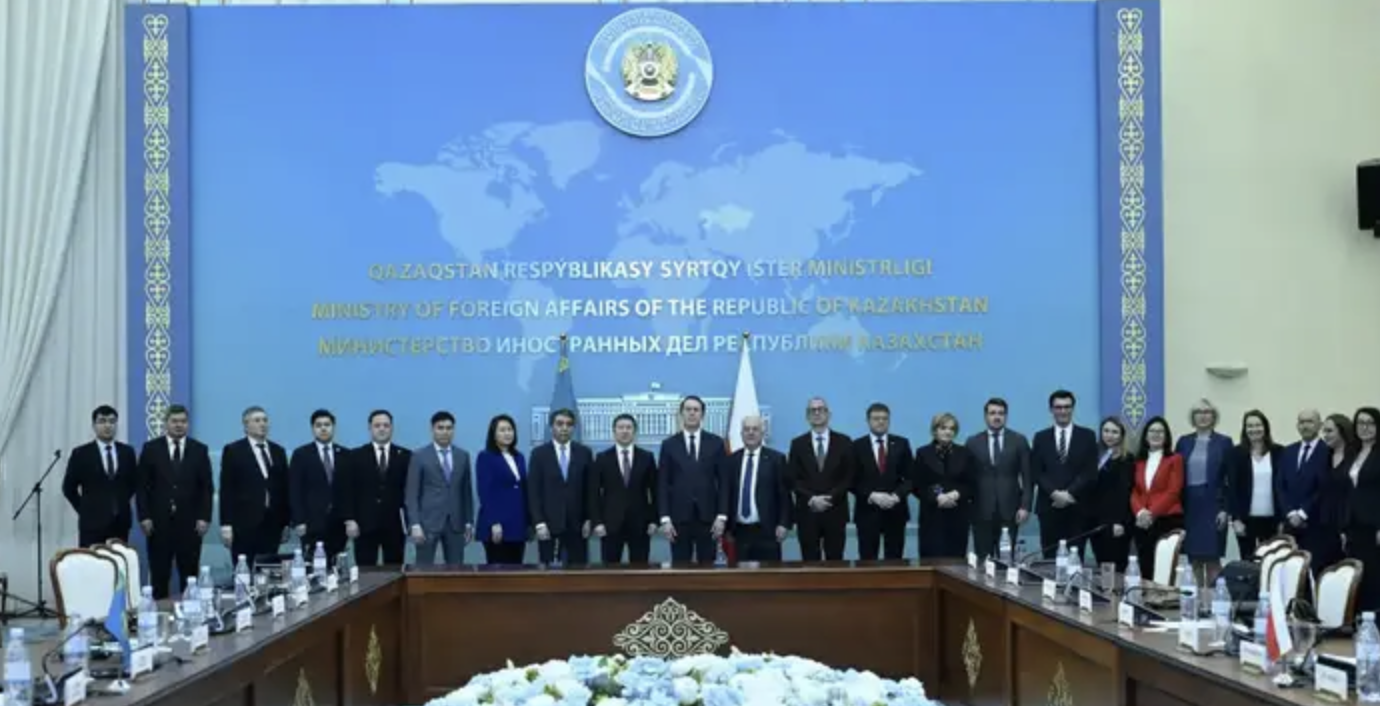
The implications of Kazakhstan’s migration reforms extend to its economic and academic partners. Poland serves as a pertinent European example. More than 120 business representatives participated in the Kazakhstan–Poland Business Forum held in Astana in April 2026. Bilateral trade exceeded USD 1.2 billion in 2025, and approximately 150 companies with Polish investment were operating in Kazakhstan. Cooperation spans sectors such as transport, energy, agriculture, pharmaceuticals, and digital technologies, where specialist mobility may become increasingly significant.
For Polish and other European companies expanding operations in Kazakhstan, more predictable pathways for qualified specialists could reduce barriers to investment and long-term cooperation. Academic mobility may further reinforce this process; Kazakhstan is included in the Polish National Agency for Academic Exchange incoming programme for 2026/2027. Migration policy thus influences not only labour supply but also Kazakhstan’s ability to transform international economic and educational relationships into sustained flows of skills, knowledge, and professional networks.
For Kazakhstan, the primary implementation challenge is domestic. Preferential migration should complement, not replace, domestic human capital development. Labour-market data indicate that shortages are concentrated rather than widespread. A selective system should adapt to evolving labour market evidence rather than rely on a static list of occupations. The expansion of the list of in-demand professions list from 51 to 174 exemplifies this issue. While a larger list may offer policymakers greater flexibility, broad qualification criteria or weak links to current labour market data may undermine the selectivity that supports the policy’s economic rationale.
Measurement presents an additional challenge. Basic metrics, such as the number of Altyn Visas, residence permits, or international students, are straightforward to monitor. However, these do not demonstrate whether migration policy is generating sustained economic value. More meaningful indicators would include skilled-migrant retention, international graduate employment, investment and job creation, professional integration, and evidence of knowledge transfer. The Ministry of Labour, in collaboration with universities, employers, and relevant government bodies, should develop a formal evaluation framework to track these outcomes over time and publish periodic scorecards or reports. Longitudinal data on migrants’ occupational trajectories and follow-up surveys of employers could further indicate whether targeted migration is contributing to productivity and capability development. Such evidence would provide a stronger foundation for benchmarking and future policy adjustments.
Key Determinants of Success
The immediate priority is to finalise the migration legislation. In May, the Ministry of Labour reported that its draft law was undergoing inter-agency coordination. On 28 August, President Tokayev called for the relevant bill to advance rapidly. The details are critical. Particular attention should be given to the definition of priority professions, the implementation of the Altyn Visa and long-term residence mechanisms, the recognition of foreign qualifications, and the transition of international graduates from study to employment and, potentially, to longer-term status.
Kazakhstan’s migration policy is shifting from a system focused primarily on restrictions and quotas to one that places greater emphasis on migrant composition and economic contribution. The concept of managed openness encapsulates this transition, but the effectiveness of the new approach will depend on its implementation.
Key indicators should include not only the number of specialists, investors, or international students arriving in Kazakhstan but also whether they stay, find meaningful work, generate investment and jobs, exchange knowledge, and address specific capacity gaps. If recruitment strategies are aligned with labour-market data and integration improves after entry, a selective openness approach could enhance Kazakhstan’s human capital and global standing. Conversely, if occupational targeting is too broad, retention is low, or success is measured mainly by initial entry figures, reforms might boost mobility but not yield lasting economic benefits. Ultimately, Kazakhstan’s success depends on what it retains, not just who it attracts.
Sources:
President of the Republic of Kazakhstan. Address by President Kassym-Jomart Tokayev, 28 August 2026, https://www.akorda.kz/ru/vystuplenie-prezidenta-kasym-zhomarta-tokaeva-na-otkrytii-pervoy-sessii-kurultaya-respubliki-kazahstan-pervogo-sozyva-2875839
President of the Republic of Kazakhstan. Decree No. 1242 of 25 April 2026, On Measures to Improve Migration Policy in Order to Create Favourable Conditions for Attracting Highly Qualified Specialists, Foreign Investors and Entrepreneurs, https://adilet.zan.kz/rus/docs/U2600001242
Government of the Republic of Kazakhstan. Migration Policy Concept of the Republic of Kazakhstan until 2030, Resolution No. 1081 of 15 December 2025, https://adilet.zan.kz/rus/docs/P2500001081
Ministry of Labour and Social Protection of the Republic of Kazakhstan. New Measures for Attracting Foreign Specialists Developed in Kazakhstan, May 2026, https://www.gov.kz/memleket/entities/enbek/press/news/details/1215562
Ministry of Labour and Social Protection of the Republic of Kazakhstan. Kazakhstan Continues to Face Personnel Shortages in a Number of In-Demand Professions, 12 May 2026, https://www.gov.kz/memleket/entities/enbek/press/news/details/1217397
Ministry of Labour and Social Protection of the Republic of Kazakhstan. Foreign-Labour Quotafor 2026, https://www.gov.kz/memleket/entities/enbek/press/news/details/1134894
Ministry of Science and Higher Education of the Republic of Kazakhstan. Kazakhstan Strengthens Its Position as an International Education Center, https://www.gov.kz/memleket/entities/sci/press/news/details/1262924
Andersson, L. (2025). Measuring and Assessing Talent Attractiveness in OECD Countries, Second Edition: Methodology Paper. OECD Social, Employment and Migration Working Papers, No. 318, https://www.oecd.org/en/publications/measuring-and-assessing-talent-attractiveness-in-oecd-countries-second-edition_133b6085-en.html
OECD. (2026). International Students in Higher Education: A Comparative Analysis of Trends, Challenges and Policy Responses. OECD Publishing, https://www.oecd.org/en/publications/international-students-in-higher-education_005ff28d-en.html
Ministry of Foreign Affairs of the Republic of Kazakhstan. Kazakhstan–Poland Business Forum in Astana: Strengthening Business Partnership, 9 April 2026, https://www.gov.kz/memleket/entities/mfa/press/news/details/1198685
Ministry of Foreign Affairs of the Republic of Kazakhstan. Prospects for Cooperation Considered at the Kazakhstan–Poland Intergovernmental Commission, 10 April 2026, https://www.gov.kz/memleket/entities/mfa/press/news/details/1198878
Polish National Agency for Academic Exchange (NAWA). Zawacka NAWA — Incoming Offer, 2026/2027, https://www.nawa.gov.pl/en/international-cooperation-and-exchange/zawacka-nawa/incoming
Tengri Education. “Все лазейки будем закрывать”: Казахстан меняет правила для иностранных студентов, 28 August 2026, https://tengrinews.kz/educationscience/vse-lazeyki-budem-zakryivat-kazahstan-menyaet-pravila-607281/
Photo credit: Ministry of Foreign Affairs of the Republic of Kazakhstan, https://www.gov.kz/memleket/entities/mfa/press/news/details/1198878
Methodological note
AI tools supported the research and verification processes for this analysis, including source identification, preliminary synthesis, and linguistic editing. All factual claims and references were verified against original or authoritative sources. The final analysis, interpretation, and conclusions, as well as responsibility for the content, remain with the author.