
Global Universities, Local Capability: Kazakhstan’s Next Higher Education Challenge
The internationalization of higher education in Kazakhstan is entering a more demanding phase. Expansion continues, but the policy question is not just how many foreign universities and programs Kazakhstan can attract, but what lasting capability they build within the country. In its 2025 higher education review, the Ministry of Science and Higher Education reported 40 strategic partnerships with leading foreign universities, including 33 operating branches. The 2026 regulatory framework sets clearer expectations for these partnerships, including local faculty development, joint research, and responsiveness to regional needs. The challenge is whether these international university partnerships strengthen local academics, institutions, regional linkages, and research networks over time.
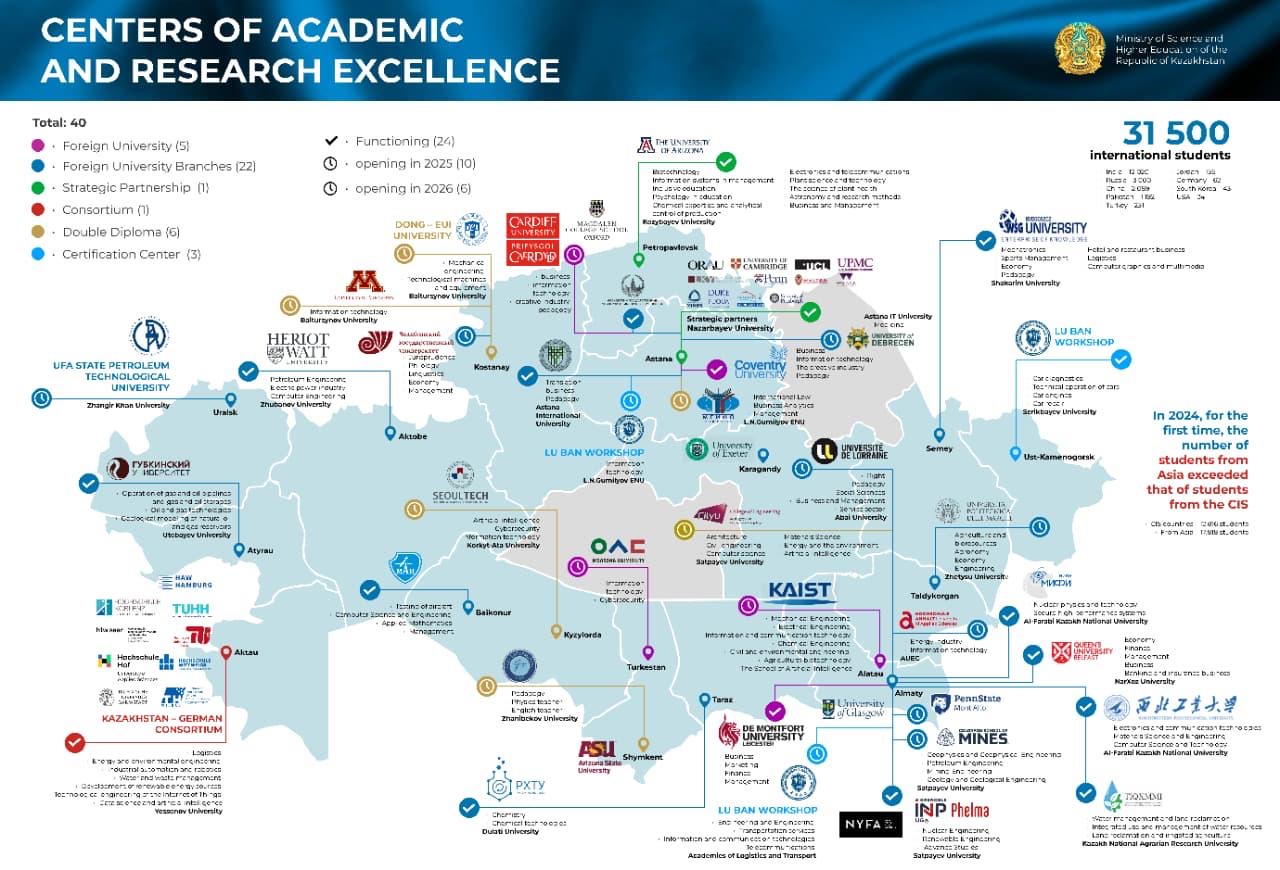
From Expansion to Strategic Expectations
Under Kazakhstan’s 2026 regulatory framework for international and foreign educational institutions, international cooperation takes several forms, including joint educational programs, double-degree programs, and strategic partnerships, as well as foreign university branches operating in Kazakhstan. These arrangements are not interchangeable, which matters when interpreting reported figures for foreign campuses, branches, and partnerships.
Several factors help explain the current expansion, but they reflect two related policy objectives. The first is capacity and access. Demographic growth is placing additional pressure on Kazakhstan’s higher education system, while the Concept for the Development of Higher Education and Science in the Republic of Kazakhstan for 2023–2029 identifies continuing challenges related to university capacity, qualified teaching staff, student housing, and infrastructure. In this context, foreign university branches can expand domestic access to international higher education, particularly for students who are unable to study abroad. Widening access also requires attention to students’ preparation in the language of instruction and the support available before and during their studies.
The second objective is economic and regional. The government also uses international partnerships to respond to sectoral and regional skills needs, improve the quality and competitiveness of higher education and strengthen Kazakhstan’s position as an education hub in Central Asia. In his 2024 State of the Nation Address, President Kassym-Jomart Tokayev noted that 23 leading foreign universities had been attracted to Kazakhstan and called for stronger links between universities and the real economy. The Ministry has similarly said that it selects international partners partly in response to workforce needs in specific sectors and requests from regions. This orientation is reflected in program choice: according to Ministry reporting, around 85% of programs within the foreign-university branch network focus on artificial intelligence, cybersecurity, engineering, and the natural and technical sciences.
The current expansion is therefore about more than increasing the number of foreign institutions. It is also expected to address domestic capacity constraints, skills needs, and regional development priorities. In 2026, these broader expectations became more specific requirements for how strategic partnerships should operate.
Ministry Order No. 191 of 16 April 2026 defines strategic partnership as involving qualified foreign faculty, the introduction of teaching methods from the partner institution, professional development for local academics through training, internships and seminars, joint research that takes regional needs into account, and the development of interdisciplinary, joint and double-degree programs.
Law No. 309-VIII of 12 June 2026 further strengthened quality-assurance requirements. Foreign university branches and foreign educational institutions must undergo accreditation within one year of establishment and provide education that meets at least Kazakhstan’s relevant state standards. Importantly, the framework already goes beyond attracting foreign institutions: its formal expectations include faculty development, research cooperation, and regional relevance. What matters more is how these expectations work in practice across different institutions.
The Ministry’s 2025 review also reports concrete inputs associated with these partnerships, including new teaching and laboratory facilities, equipment investment and, in some cases, teacher training. These developments show that internationalization is generating activity in areas such as infrastructure and training, but they do not yet establish whether new capabilities are being absorbed and sustained within domestic institutions.
From Access to Local Capability
Students are the most visible beneficiaries of internationalization, but access tells only part of the story. For this analysis, local capability spans four related dimensions: academic capability, institutional capacity, regional and employer linkages, and durable academic and research networks.
Local faculty are therefore central to the analysis. Training and exposure to different teaching practices can be useful, but deeper institutional benefits depend on whether local academics become active participants in teaching, research, and international academic networks.
A 2020 study by Kuzhabekova and Lee on internationalization and local research capacity in Kazakhstan provides a useful reference point. The authors found that international academics shared explicit knowledge through publications and tacit knowledge through their work with students, while remaining comparatively disengaged from efforts to strengthen local academics’ research capacity. They linked this disengagement to unclear expectations about international faculty roles, ineffective reward structures, and the lack of tenure contracts. The study predates most of the current wave of foreign-university expansion and cannot be used to assess today’s partnerships. It nevertheless points to a broader lesson: opportunities for knowledge-sharing matter, but so do the incentives and responsibilities that shape how international faculty engage with local colleagues.
The 2026 requirements for strategic partnerships make outcomes for local academics particularly important. Over the next several years, relevant evidence will include whether their involvement extends beyond workshops and program delivery to sustained research collaboration, co-authorship, doctoral supervision, and professional networks they can maintain independently.
Institutional effects are harder to see and often take longer to assess. An international program may attract high-achieving students, provide quality teaching, and confer respected degrees without substantially changing the institution or system around it. How broader capability develops also depends on the organizational model. Where a partnership is embedded within a Kazakhstani university, the focus should be on whether local academics are involved in shaping curricula and research and whether knowledge and practices extend beyond the immediate program. Where an international institution operates more independently, what matters is how closely it connects with domestic universities, researchers, employers, and wider academic networks. The Concept anticipates broader effects, linking foreign university branches to the adoption of global educational standards, changes in management practices, and greater competition among domestic universities.
What matters institutionally is whether departments retain new academic or management practices, researchers sustain collaborations, and laboratories, doctoral networks, or joint research projects continue beyond individual staff members, projects, or funding arrangements.
These developments must also be viewed alongside Kazakhstan’s broader reforms in higher education and science. The Concept also includes measures to strengthen university research, promote commercialization, and deepen links between science, business, and industry. Improvements in these areas should therefore not be attributed solely to the presence of international universities. A more useful way to assess their contribution is to ask whether international partnerships reinforce these wider reforms and strengthen domestic institutions’ capacity to participate.
Regional Impact and Central Asian Connections
The location of international partnerships also matters. The Ministry reports that it selects foreign university partners partly in response to sectoral workforce needs and regional requests. In Aktobe, for example, the Heriot-Watt partnership at Zhubanov University offers programs in Electrical and Electronics Systems, Petroleum with Transition Engineering, and Computational Sciences with Software Engineering. This gives internationalization a potential role in regional development. Specialized programs, academic networks, and new institutional practices can strengthen regional universities and bring them into closer contact with employers.
But program design and eventual impact are not the same thing. A program tailored to labor-market demand does not by itself strengthen a regional economy. More meaningful evidence will emerge over time: whether employers remain involved, whether graduates find relevant opportunities locally, whether research partnerships develop, and whether the host university itself gains stronger teaching, research, and partnership capacity. This does not mean that every graduate must remain in the region or that every partnership should produce immediate economic effects. A more realistic measure is whether relationships between universities, employers, and regional institutions are sustained and create opportunities beyond the program itself.
The regional dimension also extends beyond Kazakhstan through growing higher-education connections across Central Asia. In June 2026, a UNESCO-supported policy dialogue in Astana brought together education authorities, universities, international organizations, and experts from across the region. The dialogue focused on qualification recognition, quality assurance, academic mobility, and flexible learning pathways, with the development of a regional roadmap to 2030 among its objectives.
Kazakhstan is moving in both directions: it is hosting foreign universities while also expanding the international presence of its own institutions. Recent Ministry reporting indicates a growing presence of Kazakhstani universities abroad, while the Concept explicitly provides for opening branches of Kazakhstani higher-education institutions outside the country. This two-way expansion broadens the regional dimension of Kazakhstan’s internationalization and supports its ambition to strengthen its position as a regional education hub.
From a capability perspective, the number of cross-border campuses is less important than what these connections enable. Central Asia is not yet a fully integrated higher-education area, and national systems continue to pursue distinct internationalization strategies. Regional cooperation will become more consequential if it makes academic mobility easier, supports joint research, improves qualification recognition, and creates institutional relationships that can be sustained across borders.
Measuring Lasting Capability
It is still too early to assess the long-term, system-wide effects of Kazakhstan’s current wave of higher-education internationalization. Kazakhstan has a much longer history of international cooperation in higher education; what is relatively new is the scale and speed of the current expansion. Some of the most important rules governing international and foreign educational institutions and strategic partnerships were introduced only in 2026.
This is why the choice of indicators matters. Student enrollments, new programs, and partnership numbers remain useful measures of access and expansion, but they cannot by themselves demonstrate institutional transformation.
Together, these four dimensions offer a practical way to assess what the partnerships are actually building. For academics, relevant evidence would include collaboration and professional networks that remain active beyond program delivery. At the institutional level, it would include whether academic and management practices and research capacity extend beyond individual programs. Regional impact would be reflected in ongoing employer engagement, relevant graduate opportunities, and university-industry collaboration. At the network level, the key criterion is whether academic and research relationships can be maintained across institutions and borders rather than depending primarily on individual projects or foreign participants. Alongside campuses, programs, and student numbers, evaluation therefore needs to follow changes within participating domestic institutions and the relationships they build with academics, employers, and research partners over time.
These outcomes will take longer to emerge than new campuses or degree programs. Kazakhstan has already demonstrated that it can establish international university partnerships at scale. The harder test is whether the capabilities associated with these relationships become embedded in domestic institutions and can be sustained over time.
If they do, internationalization will have moved beyond importing educational provision toward building domestic capability. That is the more meaningful measure of success.
Sources:
Government of the Republic of Kazakhstan. Resolution No. 248 of 28 March 2023, On Approval of the Concept for the Development of Higher Education and Science in the Republic of Kazakhstan for 2023–2029. https://old.adilet.zan.kz/rus/docs/P2300000248
Ministry of Science and Higher Education of the Republic of Kazakhstan. Казахстан – территорияакадемических знаний: ключевые итоги 2025 года [Kazakhstan – Territory of Academic Knowledge: Key Results of 2025].https://www.gov.kz/memleket/entities/sci/press/news/details/1132261?lang=ru
President of the Republic of Kazakhstan. President Kassym-Jomart Tokayev’s State of the Nation Address “Just Kazakhstan: Law and Order, Economic Growth, Social Optimism.” 2 September 2024. https://primeminister.kz/en/addresses/02092024
Ministry of Science and Higher Education of the Republic of Kazakhstan. Интернационализация вузовКазахстана: шаг к стандартам международного образования [Internationalisation of Kazakhstan’s Universities: A Step Towards International Education Standards]. https://www.gov.kz/memleket/entities/sci/press/news/details/919551?lang=ru
Ministry of Science and Higher Education of the Republic of Kazakhstan. Ключевые направленияразвития высшего образования и науки [Key Directions for the Development of Higher Education and Science]. https://www.gov.kz/memleket/entities/sci/press/news/details/1098845?lang=ru
Ministry of Science and Higher Education of the Republic of Kazakhstan. Order No. 191 of 16 April 2026, On Approval of the Rules for the Activities of International and Foreign Educational Institutions in the Republic of Kazakhstan and/or Their Branches and Forms of Cooperation. https://old.adilet.zan.kz/rus/docs/V2600038479
Republic of Kazakhstan. Law No. 309-VIII of 12 June 2026, On Amendments and Additions to Certain Legislative Acts of the Republic of Kazakhstan on the Status of Teachers, Education, Healthcare and Protection of Children’s Rights. https://old.adilet.zan.kz/rus/docs/Z2600000309
Kuzhabekova, A., & Lee, J. T. (2020). Internationalization and Local Research Capacity Strengthening: Factors Affecting Knowledge Sharing Between International and Local Faculty in Kazakhstan. European Education, 52(4), 297–311. https://doi.org/10.1080/10564934.2020.1723422
UNESCO. Central Asia strengthens cooperation in higher education: UNESCO and Kazakhstan to hold a regional policy dialogue in Astana. 17 June 2026. https://www.unesco.org/en/articles/central-asia-strengthens-cooperation-higher-education-unesco-and-kazakhstan-hold-regional-policy
Ministry of Science and Higher Education of the Republic of Kazakhstan. Изменения и реформы в области высшего образования и науки за шесть лет [Changes and Reforms in Higher Education and Science over Six Years]. https://www.gov.kz/memleket/entities/sci/press/news/details/960302?lang=ru
Heriot-Watt University. K. Zhubanov Aktobe Regional University, Kazakhstan. https://www.hw.ac.uk/about/international-partnerships/zhubanov-university-kazakhstan
Photo credit: Ministry of Science and Higher Education of the Republic of Kazakhstan.
Methodological Note
AI tools supported source identification, preliminary synthesis of sources, and language editing for this analysis. The author remains responsible for the final analysis, interpretation and conclusions.