
Lebanon Between Negotiations and Escalation: The State Seeks to Regain Control over Security Policy
Negotiations over southern Lebanon are testing the state’s ability to regain control over security policy. Their prospects depend on linking Israeli withdrawal, the deployment of the Lebanese Armed Forces, the dismantling of military structures outside state authority, and reconstruction. UN Security Council Resolution 1701 already provides the central framework. The difficulty lies in implementing it while the parties dispute the sequence of concessions and the arrangements for verifying compliance. The problem of southern Lebanon extends beyond the border with Israel. Formal responsibility for security rests with Lebanese institutions, yet Hezbollah has maintained weapons, command structures and the ability to conduct military operations independently of the government. Successive efforts to contain the fighting have not resolved this division of authority. Joseph Aoun’s election as president on 9 January 2025 and the formation of Prime Minister Nawaf Salam’s government on 8 February ended a prolonged institutional vacuum. They did not, however, give the state effective control over every armed actor. The question is whether restored constitutional institutions can translate their formal authority into decisions that can be enforced.
Resolution 1701: The Framework Already in Place
UN Security Council Resolution 1701, adopted on 11 August 2006, remains the central reference point. It calls for a full cessation of hostilities and links Israeli withdrawal to the deployment of Lebanese forces and UN peacekeepers. It also envisages an area between the Blue Line and the Litani River in which only the Lebanese state and UNIFIL are authorised to maintain armed personnel, weapons, and military assets. Resolution 1559 of 2 September 2004 had already called for the disbanding and disarmament of Lebanese and non-Lebanese militias and the extension of government control throughout the country.
UNIFIL was established under Resolutions 425 and 426 in 1978, with its mandate expanded by Resolution 1701. Its responsibilities include monitoring the cessation of hostilities, supporting the Lebanese army’s deployment, and assisting it in establishing the required security arrangements in the south. The mission therefore provides an existing mechanism for observation, liaison, and reporting. Its mandate does not make it responsible for forcibly disarming Hezbollah throughout Lebanon.
This distinction is essential. International personnel can help verify compliance, but Lebanese institutions must assume responsibility for controlling territory and weapons. Deploying more observers would have limited value if the state remained unable to act on their findings. Equally, the presence of a monitoring mission cannot by itself secure Israeli withdrawal or prevent every violation.
A Ceasefire Barely Visible on the Ground
Events on 6 September illustrated the gap between diplomatic arrangements and conditions in the south. Israel carried out strikes that it described as a response to Hezbollah drone attacks against its troops on Lebanese territory. An initial Lebanese Health Ministry toll recorded four deaths. A later report by Sky News, citing the ministry, put the death toll for the day at seven, including two women. That total included three people killed in a separate drone strike in Nabatieh Al-Tahta.
President Joseph Aoun’s office said the strikes had destroyed a hospital and damaged a Finance Ministry building. Israel said it had targeted Hezbollah military infrastructure and described the hospital building as disused and used for military purposes. The competing accounts did not independently establish how the facility was being used at the time of the strike.
These disputes have consequences beyond the assessment of individual attacks. Israel invokes Hezbollah’s military infrastructure to justify continued operations; Lebanese authorities point to violations of the ceasefire and Lebanon’s sovereignty. Hezbollah can use the strikes to reinforce its argument for retaining weapons. Renewed violence thus risks weakening the government’s claim that negotiations can deliver effective protection.
Ali Al-Taher: Operational Gains and the Limits of State Control
The Ali Al-Taher ridge near Nabatieh illustrates the difference between a military gain and a political outcome. On 3 September, the Israeli military said its forces had cleared two major tunnel routes beneath the ridge and were preparing to demolish the infrastructure. It described the area as being under its operational control. These were Israeli military claims, rather than independently verified findings about the entire underground complex.
Even if such gains were confirmed, they would not establish that Lebanese institutions had regained control of the area. Restricting Hezbollah’s movement, destroying tunnels and transferring responsibility to the Lebanese state are separate steps. Progress in one does not automatically translate into progress on the others.
For the Lebanese army, an effective handover would require access to the area, the ability to inspect military infrastructure and sufficient authority to prevent armed groups from returning. A deployment without these conditions could leave the state formally present but operationally constrained. The relevant measure of progress is therefore whether the army can exercise lasting control after Israeli forces withdraw.
Negotiations as an Attempt to Restore State Authority
U.S.-mediated negotiations concern the implementation of security arrangements, including phased Israeli withdrawal and the verification of disarmament. The framework agreed on 26 June provides a basis for these discussions. It should not be confused with a comprehensive peace treaty or with the completion of the measures under negotiation.
Beirut’s participation is politically significant because the government is negotiating responsibilities that it does not yet have the capacity to exercise fully. Its objective is to reassert its authority over decisions that have long been contested by an armed organisation operating outside the state’s chain of command.
A limited confidence-building measure took place on 3 and 4 September. The International Committee of the Red Cross confirmed that it facilitated the transfer to Lebanon of five people released from Israeli detention: one on Thursday, 3 September, and four on Friday, 4 September. The figure of five therefore covers both transfers. The ICRC described its role as that of a neutral humanitarian intermediary.
The releases did not alter the military balance, but they showed that practical arrangements could be implemented despite continuing violence. Their political significance lies in demonstrating that negotiations can produce identifiable results. That does not establish progress on the more difficult questions of weapons, territory, and enforcement.
For Hezbollah, the process presents a political challenge as well as a military one. If the government secures Israeli withdrawal, establishes effective control in the south, and organises reconstruction, it could weaken the argument that an independent military apparatus is indispensable. Failure would give Hezbollah greater scope to present the state as incapable of protecting the population.
The dispute over weapons consequently concerns the distribution of authority within Lebanon. Disarmament would change the organisation’s influence over strategic decisions. A coercive attempt could, however, provoke internal confrontation. A phased approach would need verifiable steps that transfer capabilities and responsibilities to state institutions, rather than merely postponing the dispute.
The Trap of Mutual Preconditions
The central obstacle is the sequencing of implementation. Israel has demanded verified action against Hezbollah’s military infrastructure before further withdrawals. Hezbollah has rejected the disarmament process, while continued Israeli operations strengthen its argument for retaining weapons. The Lebanese army is expected to assume responsibility in areas where access and the conditions for deployment remain contested.
Each side can therefore make its next step dependent on an action by the other. Israeli forces remain while citing Hezbollah’s armed presence; Hezbollah points to those forces as justification for maintaining its own. The Lebanese government bears political and economic costs without exercising full control over the decisions that generate them.
Military pressure may produce local gains while making the political transition harder. Strikes causing civilian casualties and damage to infrastructure can undermine public confidence in the government’s negotiating strategy. The more difficult it becomes for Beirut to demonstrate that diplomacy improves security, the more room Hezbollah has to challenge that strategy.
Breaking this cycle would require reciprocal, verifiable steps. The practical issue is whether withdrawal from a defined area can be matched by Lebanese deployment and effective control over weapons in that area. A sequence built around observable implementation would be more credible than demands for the other side to fulfil every obligation first.
UNIFIL and the Future of Verification
The debate over international verification takes place alongside an existing UN mission. Resolution 2790, adopted on 28 August 2025, extended UNIFIL’s mandate for a final time until 31 December 2026 and provided for its orderly withdrawal within the following year. It also called for options to support the implementation of Resolution 1701 after UNIFIL’s departure. The planned transition gives the negotiations an additional deadline: responsibility for monitoring and supporting the Lebanese army must be addressed before existing capabilities disappear.
Reports about a possible additional mechanism should be treated separately from UNIFIL’s established mandate. On 12 August, Reuters reported that Britain, Italy, Switzerland, and Indonesia were being considered as contributors. A Lebanese official disputed the existence of an agreed shortlist the following day and said discussions with Washington were continuing. These reports did not establish that a mission had been agreed upon, who would participate in it, or what authority it would have.
Any successor or supplementary arrangement would need a clear relationship with the Lebanese army and the applicable UN framework. Its usefulness would depend on access to the areas and facilities it was expected to inspect, consistent reporting, and an agreed response to violations. A mandate to observe without a workable procedure for addressing obstruction could reproduce the gap between formal commitments and implementation.
Reconstruction in an Economy Already in Crisis
The renewed conflict struck an economy that had been in a deep financial and institutional crisis since 2019. According to the World Bank’s March 2025 assessment, the cumulative decline in real GDP since 2019 had approached 40 per cent by the end of 2024. The damage from successive rounds of fighting compounded an existing collapse in economic capacity.
In its August 2026 assessment, the World Bank estimated real GDP growth of 4.2 per cent in 2025. That was a partial rebound from a severely reduced base. It did not mean that the banking crisis, unsustainable public debt, or constraints on public services had been resolved. The same assessment projected a contraction of 6.4 per cent in 2026 and inflation of 17.5 per cent. These were forecasts, rather than final annual outcomes.
The significance of the renewed deterioration extends beyond lost output. A financially constrained state has less room to fund the army, restore infrastructure, and sustain public administration. Where public services remain inadequate, households may depend more heavily on support provided through local political networks. Economic weakness can therefore help preserve the influence of non-state actors even when their military capacity has been reduced.
Reconstruction consequently requires both security and institutional reform. Restoring buildings without resolving constraints on banking, public finance, and transparent spending would leave the recovery vulnerable. Conversely, financial reforms would struggle to generate investment if renewed destruction remained a persistent risk. Donors and investors must be able to assess how projects will be protected, funded, and supervised.
This makes reconstruction part of the contest over state authority. If public institutions can deliver services and oversee funds credibly, they gain practical legitimacy. If assistance is fragmented across competing political structures, it may reinforce the same divisions that negotiations are intended to reduce.
Scenarios and Indicators of Change
The early-September evidence points to a risk of prolonged negotiations accompanied by intermittent violence. The parties have demonstrated an ability to implement limited humanitarian measures, while the core disputes over withdrawal, weapons, and verification remain unresolved. This supports a conditional scenario of continued talks and localised confrontation, rather than a firm prediction of either a comprehensive settlement or an immediate escalation to full-scale conflict.
A more favourable trajectory would involve observable transfers of responsibility: Israeli withdrawal from specified areas, effective Lebanese army access, verified removal of unauthorised military infrastructure, and fewer attacks. Progress would also require agreement on how monitoring will continue as UNIFIL withdraws. Reconstruction financing and credible oversight would help determine whether improved security can translate into stronger state institutions.
An adverse trajectory could begin with an attack causing heavy casualties, a breakdown in negotiations over withdrawal, or an attempt at disarmament that triggers internal clashes. Such developments could reduce the political space for reciprocal steps and return the process to military confrontation.
Conclusions
The negotiations concern who can make and implement security decisions in Lebanon. The government of President Aoun and Prime Minister Salam operates within restored constitutional institutions, but the state’s authority remains constrained by Hezbollah’s military autonomy, Israeli operations, and the economic crisis.
Resolution 1701 provides a framework against which implementation can be assessed. The approaching end of UNIFIL’s operational mandate adds urgency to the question of who will monitor compliance and support the Lebanese army afterwards. A new arrangement will be useful only if it helps Lebanese institutions exercise responsibilities they can sustain.
Success would therefore require progress on withdrawal, state control over weapons, the army’s capacity, and reconstruction. Military operations may degrade Hezbollah’s infrastructure, but they cannot by themselves establish legitimate and durable state authority. Negotiations can define reciprocal steps, but their value depends on implementation. The decisive test is whether Lebanese institutions gain effective responsibility for the security of the territory they are expected to govern.
Sources:
https://www.un.org/unispal/document/auto-insert-186298/
https://digitallibrary.un.org/record/529421
https://unifil.unmissions.org/en/node/28366
https://peacekeeping.un.org/en/news/the-un-sees-peace-on-the-lebanese-horizon
https://unifil.unmissions.org/en/news/security-council-extends-unifils-mandate-resolution-2790-2025
https://dppa.un.org/en/news/this-week-in-dppa-8-14-february-2025
https://petra.gov.jo/pma/index.php/en/news/israeli-strikes-on-southern-lebanon-kill-4-injure-20
https://news.sky.com/story/four-killed-in-israeli-strikes-on-southern-lebanon-13582240
https://www.newarab.com/news/israeli-strikes-kill-one-south-lebanon-rome-talks-stall
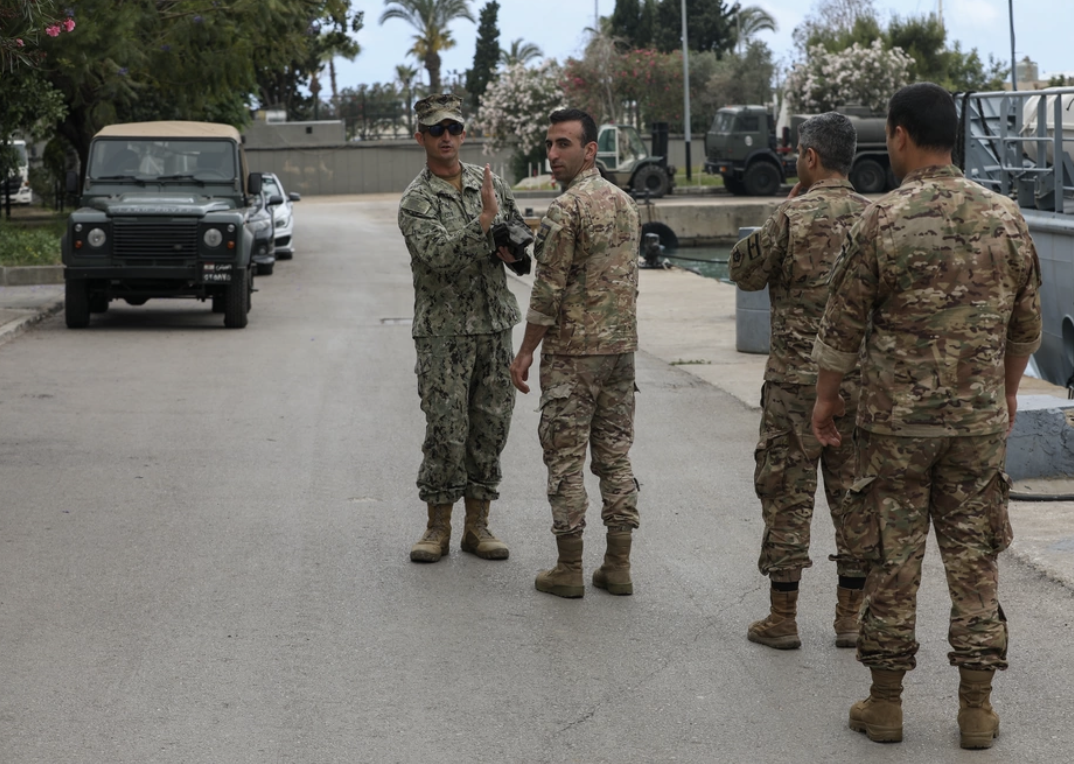
Photo credit: 230509-A-CY959-2085 JOUNEIH, Lebanon (May 9, 2023) Sailors assigned to Maritime Expeditionary Security Squadron 4 and members of the Lebanese Armed Forces practice maritime communication procedures in Jounieh, Lebanon, May 9, 2023. (U.S. Army photo by Cpl. Jensen Guillory).